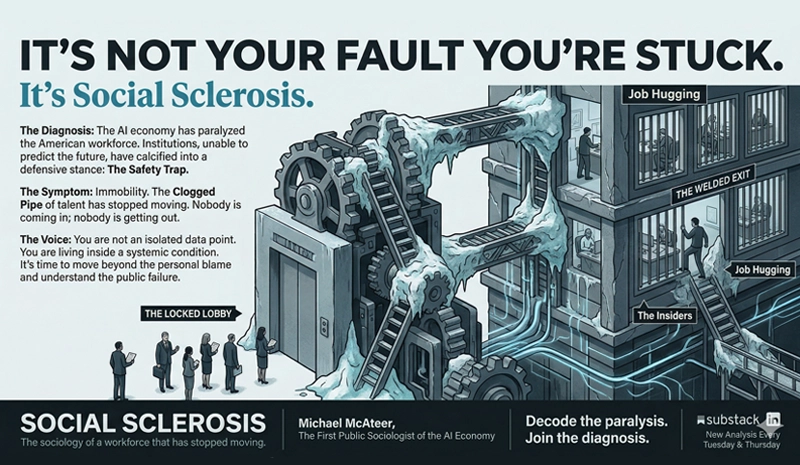
A public sociology platform built to name what millions of workers are living but nobody has diagnosed — launched in days, earning media attention before the platform existed.
3,600
LinkedIn impressions — one comment, no platform yet
2 days
Concept to full editorial framework
1
Journalist inquiry before the first article published
$0
Ad spend to generate all of it
01 / Problem
Every serious disruption in economic history eventually gets a name. The Great Depression. The Great Resignation. The name matters because it converts a private experience into a public conversation — and once something has a name, people can stop blaming themselves for it.
The 2026 labor market is the most consequential workforce disruption since the Depression. AI has paralyzed institutional decision-making at every level. Companies don't know what their workforce looks like in eighteen months. Workers don't know which skills will be obsolete. Nobody is moving. And because nobody is moving, everyone assumes the stillness is their fault.
It isn't. It's the system.
The gap in the market
Pundits had hot takes. Academics had papers locked behind journal paywalls. Data journalists had charts. Nobody had a public-facing sociological framework in plain language, built for the people living inside the condition. That gap was the opportunity.
02 / The Insight
In early April 2026, I left a comment on a LinkedIn post about Department of Labor jobless claims data. I wasn't thinking about building a platform. I was reacting to a number that wasn't telling the full story.
The comment got 3,600 impressions. A journalist reached out within days.
That signal was the only validation I needed. I had spent eighteen months inside this labor market as a participant, not an observer — applying for roles I would have landed in any prior cycle, watching the callbacks not come, and using my sociology training to understand why. I wasn't just someone with an opinion about the labor market. I was a case study inside my own framework.
The sociological unlock
C. Wright Mills's sociological imagination — the ability to distinguish between personal trouble and public issue. In the Great Depression, millions of unemployed workers blamed themselves for a structural failure. The same dynamic is playing out in 2026, with AI as the new driver. I had the framework. The market confirmed the appetite.
03 / Strategy
Most people start a publishing platform by writing. I started by building the intellectual architecture — because without a framework, you're just producing content. With one, every piece you publish compounds.
Layer 01 — The Condition
Social Sclerosis
A society or economy that loses its capacity for movement and hardens into paralysis. Institutions stop adapting. Workers stop moving. The connective tissue of economic life calcifies.
Layer 02 — The 2026 Case Study
The Safety Trap
Fear of movement at every level producing collective paralysis. Two populations trapped inside it: Insiders with Welded Exits and Outsiders facing a Locked Lobby.
Layer 03 — The Metaphor System
Proprietary vocabulary
A glossary of visual concepts — The Clogged Pipe, Job Hugging, The Painted Door, The Algorithm of Fear — that makes abstract structural forces tangible and memorable. Intellectual property, not decoration.
Publishing Architecture
04 / Execution
Framework Development
Eighteen months of lived experience into a three-layer system
Named the condition, named the populations, named the behaviors. Built a proprietary metaphor glossary to make structural sociology accessible without dumbing it down.
Platform Launch
Substack as intellectual home base
Established Tuesday/Thursday publishing cadence. First two pieces in production at launch. Each piece engineered to function as a standalone argument and a potential book chapter.
LinkedIn Strategy
Engineered for organic distribution
One observation in plain language that names something people already feel but haven't articulated. Link in comments, not post body. No more than three hashtags. No ad spend.
Media Positioning
A clear identity in a crowded space
Not a pundit, not a data journalist, not a career coach. A sociological architect diagnosing structural forces from inside the experience. First journalist inquiry received within days of launch.
05 / Results
Social Sclerosis is a platform in early traction, not a finished product. That's exactly why it's documented here. The foundation is in place. The framework is documented. The publishing cadence is live. The media positioning is ready for outreach.
3,600
Impressions, one comment, no platform
1
Journalist inquiry before first article
584
LinkedIn followers with measurable growth
$0
Total ad spend to generate all of it
The CMO-facing bottom line
Building an audience from zero, with no budget, using only a framework and a consistent voice, is exactly what I do for clients. Social Sclerosis is what it looks like when I do it for myself — in public, in real time, with the results posted here as they come in. This isn't a personal project. It's a live demonstration of the methodology.
Next Case Study
AI Product Development
TradesSnap.US →
An AI marketing engine that converts a contractor's job site photos into Google Business posts, local SEO case studies, and social content — automatically, in under two minutes.
Want to work with someone who builds in public?
If you're looking for a Fractional CMO who can build audience, framework, and media presence from zero — with no ad spend — let's talk.