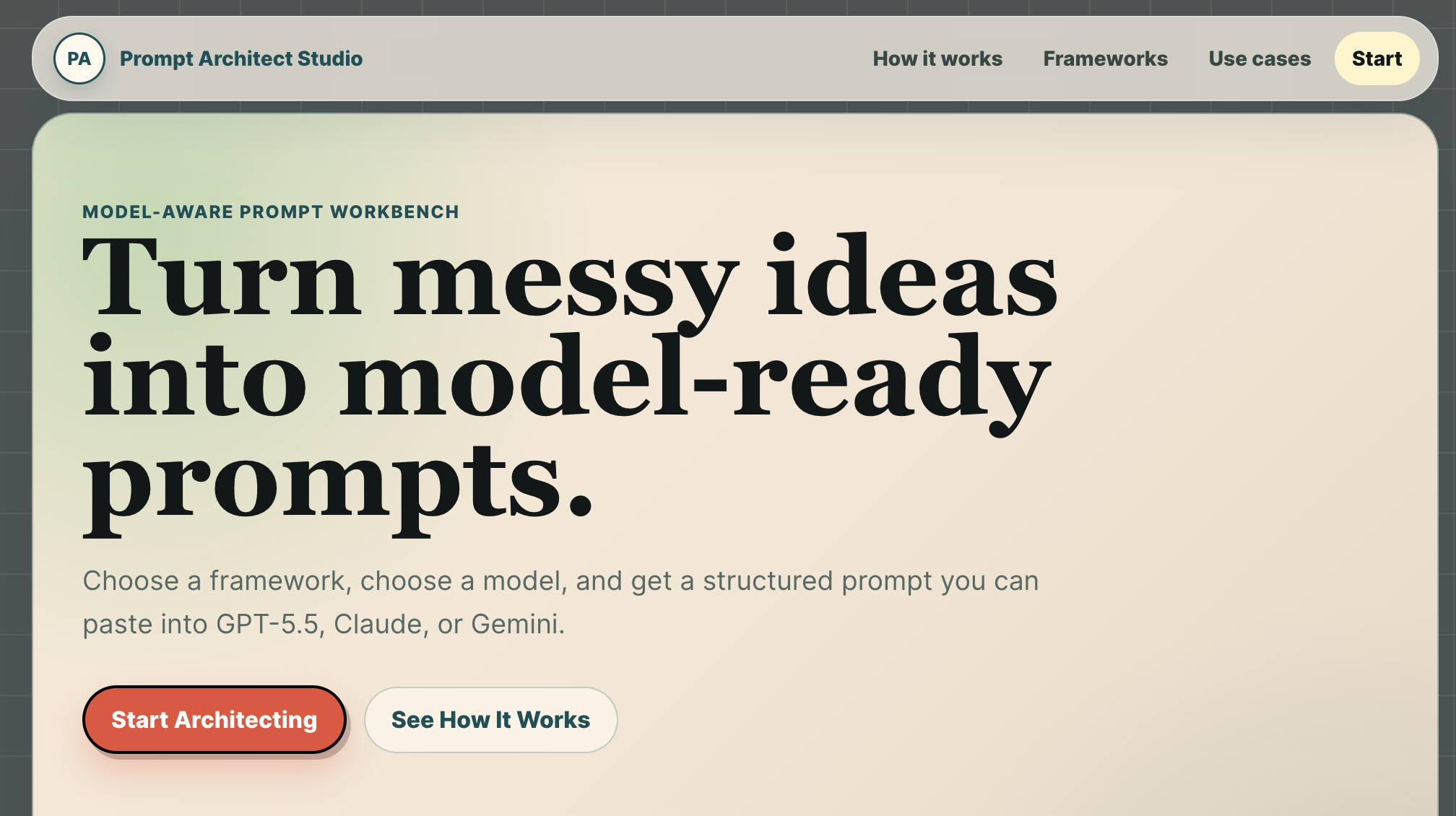
A model-aware prompt workbench that translates rough, natural-language ideas into structured, token-efficient prompts — tuned for the specific model the user is targeting: Claude, Gemini, or ChatGPT.
3
Major model families supported (Claude, Gemini, GPT)
~60%
Fewer tokens vs. unstructured natural-language prompts
< 30s
From messy idea to model-ready prompt
0
Prompt engineering experience required
01 / Problem
The average professional now uses ChatGPT, Claude, or Gemini at least once a week — but almost none of them have ever read a prompt engineering guide. They type the way they think: a sloppy sentence, a half-finished thought, a paragraph that drifts. The model does its best, but the output is mediocre, and the user blames the tool.
Underneath every disappointing AI session is the same gap: humans write conversationally, but LLMs respond best to structure. Roles, constraints, examples, output format, target audience — the pieces a model needs to do its best work are exactly the pieces a busy professional doesn't know to include.
The core diagnosis
There is a translation layer missing between how humans naturally communicate and how LLMs are engineered to respond. Prompt Architect Studio is that translation layer — built so an average user can get expert-level output without ever learning the rules behind it.
02 / Market
Prompt Architect Studio is designed for the user in the middle — past their first ChatGPT session, but nowhere near a "prompt engineer." It also has to serve two adjacent audiences: power users who want consistency across models, and the LLMs themselves, which each have different formatting preferences.
The product respects all three. A single workbench, three audiences silently optimized for.
The Everyday User
The Primary Customer
The Power User
The Multi-Model Operator
The Model
Claude · Gemini · ChatGPT
03 / Solution
The interface is built around a single, low-friction loop. A user types — or pastes — a rough natural-language idea. They pick a prompting framework tuned to the task they're trying to accomplish, and a target model — Claude, Gemini, or ChatGPT. The system rewrites their input into a structured, model-specific prompt they can paste directly into the LLM of their choice.
Behind that simplicity is the real design work: knowing which structural patterns each model rewards, where token bloat usually hides in conversational input, and how to preserve user intent while compressing it into the form the model wants to see.
How it works
Input
Architecture Engine
Translation Layer
Role · Context · Constraints · Format · Model-specific tuning · Token compression
Model-Ready Output
The strategic insight
Prompt engineering courses sell users on becoming experts. Prompt Architect Studio sells them on never needing to. The product wins by making structure invisible — the user keeps writing like a human, and the tool quietly hands a model exactly what it wants.
04 / Execution
Research & Framing
From observation to product brief
Studied how non-technical professionals actually use Claude, Gemini, and ChatGPT — where they get frustrated, where they over-explain, where they trail off. The pattern was clear: a friction layer between human phrasing and model preference. That gap became the product brief.
Framework & Model Mapping
Codifying structure per task and per model
Mapped a library of prompting frameworks to common task types, then layered model-specific rules on top — what Claude rewards, what Gemini expects, what GPT prefers. Built the architecture so users select a task and a model and never see the underlying rules.
Interface & UX
A workbench that disappears
Designed a single-screen workbench with two controls: framework and model. Hero copy speaks plainly — "Turn messy ideas into model-ready prompts." Every interaction was tuned so a first-time user could ship a usable prompt in under thirty seconds.
Build & Launch
Live in March 2026
Shipped Prompt Architect Studio at promptarchitectstudio.com — fully functional, framework- and model-aware, with the entire translation logic running quietly behind a single Start button.
05 / Tech Stack
Every component was chosen for low friction and broad model coverage. The product is multi-model by design — no vendor lock-in, no preferred ecosystem.
Model Coverage
AI Development
Front-End
Design & Hosting
06 / Use Cases
Prompt Architect Studio meets users wherever they already are with AI — and quietly upgrades the quality of every interaction.
Where it shows up
The value comparison
A prompt engineering course charges $200–$1,500 to teach the rules. Prompt Architect Studio quietly applies them, every time, in under thirty seconds — for users who'd never sit through the course in the first place.
07 / Results
Prompt Architect Studio launched in March 2026 as a working product — not a waitlist, not a landing page. Anyone can land on the site and walk away with a model-ready prompt within their first minute of using it.
The deeper outcome is invisible by design: every user who runs an idea through the workbench learns, by example, what a well-structured prompt looks like. The product teaches without teaching.
< 30s
From rough idea to model-ready prompt
3 models
Claude, Gemini, ChatGPT — tuned per output
~60%
Token reduction vs. conversational input
The bottom line
Prompt Architect Studio is a translation layer for the AI era — built for the millions of people who use LLMs every week but were never taught how to talk to them. Live at promptarchitectstudio.com
Next Case Study
AI · B2B SaaS · Product Design
BrandLockBox →
A brand-aware AI prompt workspace — store your brand DNA once and every AI output is automatically shaped by your voice, audience, and channel rules.
Want to build something like this?
If you're looking for an AI architect and designer who can take a concept from raw insight to a live, useful product — let's talk.